Costco Earnings Day Deep Dive — The Stock That Wins When Everything Else Breaks — March 5, 2026
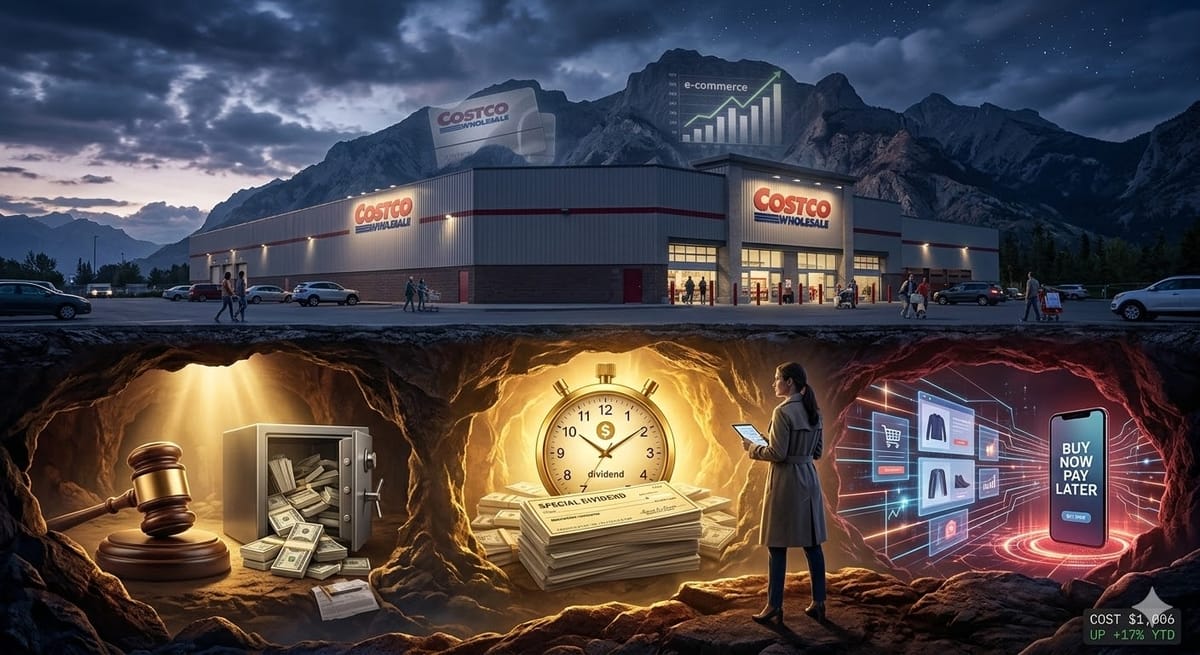
COST: $1,006.74 (March 4, 2026 close) | 52-week range: $844–$1,067 | Up +17% YTD
Costco reports Q2 FY2026 earnings after the bell tonight. Wall Street expects $4.55 EPS and $69.3 billion in revenue, up about 9% from a year ago. The stock is up 17% year-to-date, sitting just below its all-time high. And most of the coverage you'll see today will tell you the same thing: Costco is a defensive gem, tariff-proof, recession-resistant, buy-and-forget.
That's all true. But it misses three catalysts that are actually moving the needle right now — and it glosses over an important honest assessment of valuation that prospective buyers need to hear.
The Business Model That Inverts Normal Retail Logic
To understand why Costco is different, start with a simple fact: Costco barely makes money on what it sells. Its merchandise gross margins are intentionally capped at around 14–15% — well below every major competitor. The real profit engine is the membership fee. In Q1 FY2026 alone, membership income hit $1.33 billion, up 14% year-over-year, flowing through at near-100% margins.
This means Costco can undercut everyone on price while still growing profits consistently. It's not a retailer in the traditional sense — it's a membership club that happens to sell things very cheaply. With 81.4 million paid members and an 89.7% worldwide renewal rate, this income stream compounds reliably regardless of the macro backdrop.
The September 2024 membership fee increase ($60 to $65 for Gold Star, $120 to $130 for Executive) is still flowing through the income statement as a structural tailwind — adding roughly $290 million in annual operating income with no incremental cost to deliver it.
What to Watch in Tonight's Earnings Report
The consensus calls for $4.55 EPS and $69.3 billion in revenue. Given Costco's track record — 8 beats in the last 9 quarters, and a 92.5% implied probability of a beat according to prediction markets — the headline numbers are likely fine. The real signals are below the surface.
Comparable sales momentum is the first test. January comps ran at +7.1% total company (+7.3% excluding gas and FX effects). US comps were +5.8%. If Q2 comps (the October–February quarter) come in above 6%, the narrative that tariff-driven consumer anxiety is hurting Costco gets quieter.
Membership renewal rates are the heartbeat of the model. If the worldwide rate stays above 89–90%, the flywheel is intact. Management previously flagged a 5% increase in household memberships — confirmation of that trend extension would be the strongest possible forward signal.
Gross margin commentary deserves close attention in the current tariff environment. Costco has been advancing import orders, shifting sourcing where possible, and leaning on Kirkland Signature (its private label) to buffer input cost pressure. Any commentary on navigating the new 10% universal tariff — imposed by the Trump administration immediately after the Supreme Court struck down the IEEPA tariffs on February 20 — will set the tone for the back half of FY2026.
Three Catalysts Most Investors Are Underweighting
1. The Supreme Court Tariff Ruling
On February 20, the Supreme Court ruled 6-3 that the Trump administration's IEEPA-based tariffs violated federal law. Penn-Wharton estimates total tariff revenue at risk exceeds $175 billion. Costco was among the first major retailers to file suit at the Court of International Trade to preserve its refund claim — a filing made in late 2025 specifically because the company understood that waiting for the Supreme Court ruling might make refunds moot.
This optionality is not priced into the current stock. If even a fraction of those duties are recovered, the cash flow upside is material. The legal path remains uncertain — the government is fighting the refund question separately from the tariff validity question — but the optionality exists at zero cost to the base case. Companies that proactively filed, including Costco, positioned themselves ahead of those who waited.
2. The Special Dividend Clock Is Ticking
Costco has paid special dividends in 2012, 2015, 2017, 2020, and January 2024 ($15/share, its largest ever). Its cash pile swelled 43% in FY2025. The pattern is clear: Costco returns excess cash roughly every two to three years when the balance sheet allows. We are now 14 months since the last special dividend.
Management doesn't pre-announce these — they appear on earnings calls. If tonight's report includes a special dividend declaration, the stock will gap up tomorrow morning. The forward dividend yield of 0.52% makes clear that COST is not a yield stock in any traditional sense, but the irregular specials are one of the most consistent wealth-transfer mechanisms in large-cap retail. Investors who miss the announcement tend to miss the move.
3. The Digital Inflection Nobody Expected
Digitally-enabled comparable sales rose 34.4% in January. Site traffic was up 24%, average order value up 13%. Over the past four quarters, Costco's e-commerce comps have ranged from 13.6% to 20.9%, and the trajectory is accelerating. The company has deployed AI-driven product personalization, a digital wallet, door scanners to speed warehouse checkout, and Buy Now Pay Later for large purchases.
One of the standing bear arguments against Costco was that it would cede ground to Amazon and other e-commerce players. That thesis is being empirically challenged. The warehouse experience remains the draw, but digital is becoming the moat's second layer — and it changes the long-term growth ceiling in a meaningful way.
The Honest Valuation Picture
Here's what the enthusiasm around Costco often glosses over: the stock is expensive, and right now, you are paying full price.
At $1,006, COST trades at 54x trailing earnings and approximately 50x forward earnings. The consensus analyst price target from 36 Wall Street analysts is $1,016 — essentially exactly where the stock is sitting today. That means the median professional view is that the stock is fully valued at current levels. The bulls — Bank of America at $1,185, Bernstein at $1,155, Morgan Stanley at $1,225 — are betting on meaningful multiple expansion or an earnings acceleration beyond current models. That's possible, but it's not the base case.
For context, Walmart trades at roughly 34x forward earnings for comparable retail execution quality. The 15–20 multiple point premium Costco commands reflects the membership model's earnings quality, consistency, and capital efficiency. That premium is warranted — but it is already embedded in the price.
A straightforward 12-month model using 9% revenue growth, modest operating margin expansion from Kirkland private label mix and SG&A leverage, and slight P/E normalization produces a price target of roughly $1,125–$1,150. That's 12–14% upside from current levels — solid, but not exceptional for a stock that already ran 17% this year.
Competitive Positioning in a Tariff Economy
In the current environment — tariffs raising consumer goods prices, confidence weaker, Hormuz geopolitical risk elevating energy and shipping costs — Costco is unusually well-positioned. Lower-income consumers migrate toward bulk buying as unit economics favor warehouse shopping. Higher-income consumers, looking to protect their lifestyle amid price pressure, also trade toward Kirkland Signature and bulk staples. Costco is one of the very few retailers that benefits from both consumption shifts simultaneously.
Target has been visibly losing market share, with customers explicitly citing Costco as a destination for displaced spending. Walmart remains the most direct competitive threat and is executing well on e-commerce. But Costco's member loyalty — 89–90% worldwide renewal rates — insulates it from the traffic erosion that has hurt traditional grocery chains and general merchandise retailers.
The one competitive risk worth monitoring is Amazon — not as a price competitor, but as a challenger to Costco's growing digital channel. If Prime delivery quality improves further, Costco's e-commerce acceleration ceiling could be lower than current trajectory implies.
Risk Factors
Valuation vulnerability. At 54x earnings with the Fed's June cut probability hovering around 39% (constrained by Hormuz-driven energy price pressure), any earnings disappointment could trigger a 5–10% correction. This stock has priced in consistent perfection.
Labor cost inflation. Costco raised starting wages to $20/hour and will likely face further wage increases. With thin merchandise margins, this flows quickly to the P&L. Management has historically absorbed this well, but in a stagflation scenario, the margin compression could be more acute than models assume.
The tariff environment remains fluid. The Supreme Court struck down IEEPA tariffs, but the Trump administration immediately imposed a new 10% universal tariff, and the legal battle over refunds is just beginning. Any escalation directly impacts Costco's sourcing costs despite its proactive purchasing strategy.
Geopolitical macro. The Strait of Hormuz war-risk insurance cancellations are in effect as of today. A sustained energy and shipping cost spike eventually reaches Costco's merchandise cost structure, even with advanced import ordering.
My Call
Current price: $1,006.74 (March 4, 2026 close)
Rating: HOLD at current levels / BUY on pullbacks
12-month target: $1,150 base case | $1,250 bull case (special dividend + tariff refund confirmation)
Entry zone for new buyers: $950–$980
Stop loss / invalidation: $880
For existing holders, tonight is a hold-or-add decision. The business case is not in question. For new buyers at $1,007, the honest answer is that the risk/reward is balanced, not compelling. You are paying for quality and certainty — and that has a full premium attached. The $950–$980 zone, which corresponds to roughly 47–48x forward earnings, offers a more reasonable margin of safety.
The special dividend is the wild card that changes the near-term setup entirely. If announced tonight, analyst price targets ratchet immediately to $1,100–$1,200 and the stock likely opens 3–5% higher tomorrow. Investors waiting for a pullback entry may find themselves priced out if that announcement comes.
The Bottom Line
Costco is one of the best-designed businesses in American retail. Its membership model protects profitability through economic cycles, its Kirkland brand captures private-label margin, and its e-commerce channel is proving skeptics wrong. Three catalysts — a Supreme Court tariff refund path, a potential special dividend, and an accelerating digital channel — provide legitimate upside beyond the steady-compounder base case.
But the stock is fully valued today. The consensus target is essentially the current price. Investors already in the stock should stay in. Investors looking to initiate should wait for a better entry around $950–$980, or be prepared to pay full price if the special dividend announcement tonight removes that opportunity.
Costco wins when consumers are stressed. Wins when the economy is strong. Wins when tariffs raise everyone else's costs. The only variable it doesn't win on right now is valuation. Tonight's earnings call will tell us whether a special dividend announcement closes that gap decisively.
Data sources: Yahoo Finance, MarketBeat, 247wallst, TIKR, SeekingAlpha, Reuters, NPR, Barchart, MarketWatch, SimplyWallSt. Price data verified as of March 4, 2026 close. Analysis published March 5, 2026.